
SAS Liquid Allowance: Hand Luggage & Toiletries
What are the SAS liquid rules? SAS specifies a maximum 100ml per ordinary liquid container in cabin baggage, with all containers fitting one resealable 1-litre bag. SAS explicitly says a partly used larger bottle still belongs in checked baggage; it identifies toothpaste, lotion and perfume as liquids. Check your departure, transfer and return airports before packing larger containers.
At a Glance
Yes — ordinary toiletries are generally allowed if they meet departure-airport security screening and airline dangerous-goods restrictions.
SAS specifies a maximum 100ml per ordinary liquid container in cabin baggage, with all containers fitting one resealable 1-litre bag. Check each airport; rules may differ on a UK departure, connection or return.
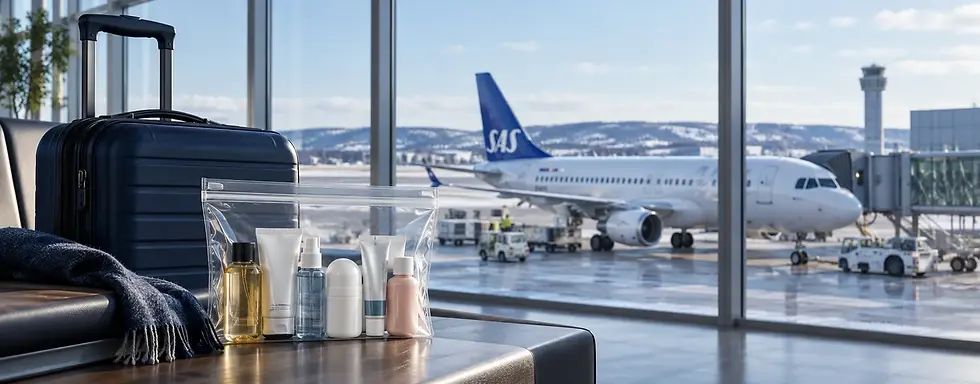
For standard 100ml screening, use one transparent resealable bag with a capacity of up to 1 litre. Follow the actual checkpoint’s instructions.
Permitted personal-care aerosols count as liquids at cabin security. Confirm separate dangerous-goods limits and protect valves against accidental release.
SAS directs larger ordinary liquid containers to checked baggage. Check your ticket’s checked allowance and any separate dangerous-goods limits.
SAS liquid allowance: which rules apply?
SAS specifies a maximum 100ml per ordinary liquid container in cabin baggage, with all containers fitting one resealable 1-litre bag.
SAS explicitly says a partly used larger bottle still belongs in checked baggage; it identifies toothpaste, lotion and perfume as liquids. Airline carriage and dangerous-goods rules still apply after airport security. Your bag allowance is determined by your booking; use the separate SAS baggage guide for fares, bag sizes and checked-bag fees.

SAS liquids in hand luggage: toiletries and security
Everyday toiletries such as shampoo, toothpaste, moisturiser, sunscreen, mascara and roll-on deodorant normally count as liquids, gels or pastes at security. SAS specifies a maximum 100ml per ordinary liquid container in cabin baggage, with all containers fitting one resealable 1-litre bag.
SAS lists baby milk or formula needed for the flight and medication or injections for personal use as exceptions, to be carried separately. A bottle holding more than 100ml does not qualify at a standard 100ml checkpoint merely because it is partly empty. At some UK airports larger containers may pass; an onward airport can still apply the traditional rule.
If transiting via Copenhagen, Stockholm or Oslo, check the airport’s transfer-screening and duty-free guidance before purchasing a large perfume.
SAS liquids in checked baggage: full-size toiletries
SAS directs larger ordinary liquid containers to checked baggage. Check your ticket’s checked allowance and any separate dangerous-goods limits.
Aerosol deodorant, hairspray, perfume, aftershave and some medicines can be regulated as dangerous goods even in the hold. Protect spray valves and confirm any airline-specific quantity limit before packing. Keep essential medication and anything needed during a delay in cabin baggage, subject to airport screening.
A checked-bag allowance is not implied by a liquids rule: check your SAS fare and the operating carrier on any connecting leg.
For cabin bag sizes, fare-specific allowances, checked baggage and fees, see our full SAS baggage guide.
Practical toiletries packing tips for your SAS journey:
Follow the airline guidance — SAS specifies a maximum 100ml per ordinary liquid container in cabin baggage, with all containers fitting one resealable 1-litre bag.
Plan the route — SAS explicitly says a partly used larger bottle still belongs in checked baggage; it identifies toothpaste, lotion and perfume as liquids.
Prepare medical items — SAS lists baby milk or formula needed for the flight and medication or injections for personal use as exceptions, to be carried separately.
Check duty-free before paying — If transiting via Copenhagen, Stockholm or Oslo, check the airport’s transfer-screening and duty-free guidance before purchasing a large perfume.
Check each checkpoint — Your departure, connection and return airports can use different liquid-screening procedures.
Read the printed capacity — At a 100ml checkpoint, a partly used 200ml bottle remains a 200ml container.
Count pastes and sprays — Toothpaste, mascara, roll-on deodorant, creams, shaving gel and many sprays count as liquids or aerosols.
Pack solids where useful — Solid soap, solid deodorant and powder cosmetics can reduce pressure on a small liquids bag.
Secure aerosol valves — Use caps or other protection against accidental discharge; check that the specific spray is permitted.
Separate full-size products — When your fare allows checked baggage, put larger ordinary toiletries there and check dangerous-goods rules for regulated products.
Check your airport’s liquids rules before flying SAS
Security rules are set by the airport and country where you are screened, alongside the airline’s carriage and dangerous-goods conditions. SAS specifies a maximum 100ml per ordinary liquid container in cabin baggage, with all containers fitting one resealable 1-litre bag.
For a UK departure, GOV.UK says most airports still limit ordinary liquids to containers of 100ml, while some permit containers up to 2 litres; check the particular airport. A connection or return flight may use a different procedure. Medicines, special dietary items, baby supplies and sealed duty-free purchases have separate conditions. SAS explicitly says a partly used larger bottle still belongs in checked baggage; it identifies toothpaste, lotion and perfume as liquids.
How common toiletries are treated at airport security
Many everyday toiletries are treated as liquids, gels, pastes or aerosols when you pass through airport security. This isn't determined by the airline you're flying with, and the exact restrictions can vary depending on the security rules and screening equipment used at your departure airport. Here's how some of the most commonly packed toiletries are generally treated:
Deodorant
Roll-on and aerosol deodorants are generally treated as liquids for airport-security purposes. Solid stick deodorants are normally treated differently and can be a useful option if you want to reduce the number of items in your liquids bag.
Toothpaste
Toothpaste counts as a paste and is treated as a liquid at airport security. Where the traditional 100ml restrictions apply, the size of the toothpaste container therefore needs to comply with the applicable liquids limit.
Shampoo and conditioner
Shampoo and liquid conditioner are treated as liquids. This also applies to similar hair products such as gels, serums and liquid styling products. Solid shampoo and conditioner bars are generally not treated as liquids.
Shaving foam and gel
Shaving gels and foams are subject to liquid-security requirements. Aerosol shaving foam may also be subject to dangerous-goods restrictions, so larger products need particular consideration if you're packing them for a flight.
Hairspray
Hairspray is an aerosol and is treated as a liquid for cabin-security purposes. Aerosol toiletries can also be subject to airline dangerous-goods limits, so check your airline's requirements as well as the security rules at your departure airport.
Sun cream
Sun creams, lotions, gels and sprays are treated as liquids for cabin-security purposes. This includes products such as after-sun lotion and moisturising sun protection. Solid sun-protection products are generally easier to accommodate when travelling with limited liquid allowance.
Make-up and cosmetics
Liquid foundation, mascara, creams, gels, lip gloss and similar products are generally treated as liquids. Solid and powder cosmetics are generally not subject to the same liquid restrictions, although they will still pass through normal security screening.
Perfume and aftershave
Perfume, aftershave and other liquid fragrances are treated as liquids at airport security. They may also fall within dangerous-goods limits applying to toiletry and medicinal articles, particularly when larger quantities are carried.
Remember: airport-security procedures are changing as new screening equipment is introduced. Some airports may allow larger liquid containers or have different requirements for removing liquids from your cabin bag. Always check the current rules for the airport you're departing from — and any airport you'll use on a connecting or return journey — before you travel.

What is the SAS liquid allowance in hand luggage?
SAS specifies a maximum 100ml per ordinary liquid container in cabin baggage, with all containers fitting one resealable 1-litre bag. The airport where you pass security may impose a different procedure, so check it as well.
Can I take toiletries on a SAS flight?
Yes. Ordinary travel-size shampoo, toothpaste, cream, sunscreen and similar toiletries can usually travel in cabin baggage when they meet the applicable airport screening and dangerous-goods rules. SAS explicitly says a partly used larger bottle still belongs in checked baggage; it identifies toothpaste, lotion and perfume as liquids.
Do SAS liquids have to go in a clear bag?
At a checkpoint using standard 100ml screening, ordinary containers normally go in one transparent resealable bag of up to 1 litre. Some airports use different procedures; check the airport before departure.
Can I take a half-empty 200ml bottle on SAS?
A partly used 200ml bottle does not meet a 100ml-per-container rule. The size printed on the container matters. Pack it in checked baggage where permitted or use a smaller travel bottle.
Can I pack full-size toiletries in SAS checked baggage?
SAS directs larger ordinary liquid containers to checked baggage. Check your ticket’s checked allowance and any separate dangerous-goods limits.
Can I carry spray deodorant or perfume on SAS?
Qualifying personal-care sprays and perfumes may travel subject to cabin screening and separate dangerous-goods rules. Check the specific article, quantity and aerosol valve protection; larger permitted items are usually easier to pack in the hold.
Can I take liquid medication over 100ml on SAS?
SAS lists baby milk or formula needed for the flight and medication or injections for personal use as exceptions, to be carried separately. Check the exact departure and transfer airport’s evidence and screening procedure.
Will duty-free liquids be allowed on a connecting SAS flight?
If transiting via Copenhagen, Stockholm or Oslo, check the airport’s transfer-screening and duty-free guidance before purchasing a large perfume. Do not assume a purchase accepted at the first airport will pass every later checkpoint.