
EgyptAir Baggage Allowance: Cabin Bags, Checked Baggage & Fees
Flying with EgyptAir? Check cabin baggage, checked-baggage allowances and fare differences before you travel.

EgyptAir's cabin allowance is straightforward, while checked baggage is more dependent on fare and route. Economy passengers can take one cabin bag up to 55 × 40 × 23cm and 8kg. Business passengers can take two cabin pieces, each up to 8kg.
Cabin baggage is one of the first things to check before travelling with EgyptAir, because the number of pieces, permitted size and weight can differ by fare or travel class. The current allowance is summarised as follows: Economy: 1 cabin bag up to 55 × 40 × 23cm and 8kg. Business: 2 cabin pieces, each up to 8kg.. Your smaller personal item, where permitted, should be suitable for stowage beneath the seat, while the main cabin bag must fit safely in the overhead locker.
Checked baggage with EgyptAir also depends on the ticket you have purchased rather than simply the destination. The current headline allowance is: International Economy checked allowance follows fare rules, generally with pieces up to 23kg; Business generally 2 × 32kg.. Lower-cost or light fares can exclude checked baggage altogether, while flexible and premium fares often provide a larger allowance. Always check the baggage entitlement attached to the individual booking before packing.
Size and weight are separate limits. A suitcase can be within the permitted dimensions but still be overweight, or it can be light enough while exceeding the airline's dimensional limit. Excess, overweight and oversized baggage charges apply; fare and route determine allowance.. Additional, overweight or oversized baggage can therefore attract extra charges or different handling requirements.
Cabin baggage must also comply with airport-security and dangerous-goods rules, which are separate from EgyptAir's own baggage allowance. Liquids, gels, pastes and aerosols may be subject to the familiar 100ml container restrictions depending on the departure and connecting airports, while power banks and spare lithium batteries normally need to remain in cabin baggage rather than being packed in the hold.
This guide explains EgyptAir's cabin and personal-item rules, checked-baggage allowances, fare and travel-class differences, liquid restrictions, additional and excess baggage, and the practical points most likely to cause problems at the airport. If another airline operates part of your journey, check that carrier's rules as well because allowances can differ across a multi-airline itinerary.
Free Cabin Bag Size
Economy:
1 cabin bag up to 55 × 40 × 23cm
8kg max
Business
2 cabin pieces
each up to 8kg
Checked Baggage Allowance
International Economy checked allowance follows fare rules, generally with pieces up to 23kg; Business generally 2 × 32kg.
Additional Baggage Fees
Excess, overweight and oversized baggage charges apply; fare and route determine allowance.
Key EgyptAir Baggage Tips
Business: 2 cabin pieces, each up to 8kg.
Economy checked pieces are normally capped at 23kg.
Business checked pieces are capped at 32kg.
Check the allowance on your EgyptAir booking before you pack. Fare, cabin and route differences can materially change what is included.
Measure bags externally, including wheels, handles and protruding pockets, rather than relying only on the manufacturer's stated suitcase size.
Weigh cabin and checked baggage at home. A bag can be within the size limit but still attract charges if it exceeds the permitted weight.
Keep the personal item genuinely small enough to fit beneath the seat if the airline requires under-seat stowage; do not treat it as a second full-size cabin bag.
If you already know you need extra checked baggage, add it before reaching the airport where the airline offers advance purchase; airport excess-baggage charges can be higher.
Where standard airport liquid rules apply, the container size matters: a partly used bottle larger than 100ml can still be rejected at security.
Pack full-size toiletries in checked baggage when appropriate, while keeping medication and anything needed during the journey accessible in the cabin.
Keep power banks and spare lithium batteries in cabin baggage, protected against short circuits, rather than placing them in the hold.

Egypt Air cabin baggage at a glance
Check the bag dimensions, weight limits and fare-specific inclusions before you travel, particularly where different fare families offer different baggage allowances.


EgyptAir baggage allowance by cabin and fare
Baggage allowances can vary by fare, route and travel class. Always check the allowance shown on your booking before you travel.
Economy Promotional
Economy Standard
Cabin baggage
1 × 8kg
55 × 40 × 23cm
Checked baggage
May be reduced
Fare rules apply
Best for
Price-focused travellers who check their exact allowance carefully.
Cabin baggage
1 × 8kg
Checked baggage
Fare-dependent
Up to 23kg per piece
Best for
Most Economy travellers on international routes.
Business
Cabin baggage
2 pieces
Up to 8kg each
Checked baggage
Generally 2 × 32kg
Best for
Business travellers carrying more cabin and checked baggage.

Checked baggage with EgyptAir: what you need to know
EgyptAir's international Economy checked-baggage allowance is determined by fare rules, with individual pieces generally limited to 23kg.
Business Class generally includes two checked pieces up to 32kg each.
Standard checked pieces must remain within 158cm total dimensions.
Some promotional fares have reduced baggage inclusions, so check the ticketed allowance carefully.
EgyptAir's checked-baggage entitlement can depend on the fare, travel class, route and the airline operating each sector. The allowance shown on your ticket or booking confirmation should therefore be treated as the final reference.
If your included allowance is not enough, additional baggage can usually be added where the airline offers this service. Arranging extra baggage before travel is generally preferable to discovering an excess at check-in.
A bag that exceeds the permitted weight, dimensions or number of pieces can be treated as excess, overweight or oversized baggage. Separate charges or handling restrictions may apply, and very heavy items may need to be repacked or carried as cargo.
For journeys involving another airline, do not assume the same checked-baggage rules apply throughout. Codeshare and interline itineraries can be governed by the operating carrier or the most-significant carrier under the applicable baggage rules.
Before travelling, check the baggage allowance attached to your specific EgyptAir booking, particularly if you have changed your ticket, upgraded your cabin or added a connecting flight.
EgyptAir cabin baggage rules: liquids, extras and restrictions
Economy passengers can take one cabin bag up to 55 × 40 × 23cm and 8kg.
Business passengers can take two cabin pieces, each up to 8kg.
Cabin baggage should fit safely in the overhead compartment or beneath the seat as directed.
Codeshare flights can use the operating carrier's rules.
Airport-security liquid restrictions apply separately.
Cabin baggage must be small and light enough to be safely stowed in the overhead locker or, for a personal item, beneath the seat in front. Published measurements normally include wheels, handles and other protruding parts unless the airline explicitly states otherwise.
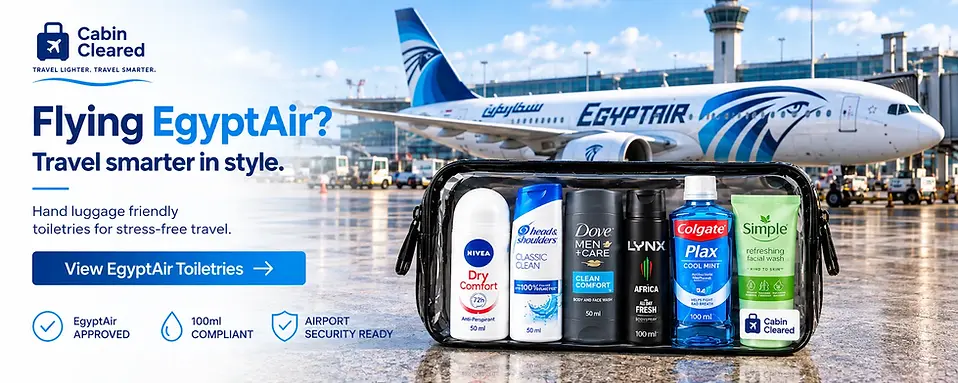
For journeys departing the UK, liquids, gels, pastes and aerosols are subject to the security rules at the departure airport. Where the standard 100ml rule applies, individual containers must normally hold no more than 100ml and be presented in the permitted transparent resealable liquids bag.
Typical products affected include toothpaste, deodorant, shampoo, conditioner, shower gel, sun cream, skincare and cosmetics. Medication, baby food and certain medical items can qualify for security exemptions when required for the journey, although supporting evidence may be requested.
Power banks and spare lithium batteries should be carried in cabin baggage rather than checked baggage and protected against short circuits. Other dangerous or restricted items can be prohibited entirely or limited to either cabin or checked baggage.
EgyptAir staff or airport handling agents may check cabin baggage at check-in or the gate. A bag that exceeds the permitted number, size or weight can be placed in the hold and additional charges may apply.
Common EgyptAir cabin baggage mistakes to avoid
Assuming every fare includes the same cabin-baggage allowance
Forgetting to include wheels and handles when measuring a bag
Using a personal item that is too large to fit beneath the seat
Packing liquids in containers larger than 100ml where standard airport restrictions apply
Assuming a partly empty large liquid container is security compliant
Packing power banks or spare lithium batteries in checked baggage
Ignoring different baggage rules on a partner-operated or connecting flight
Arriving at the airport without checking the allowance shown on the booking
EgyptAir cabin baggage rules: liquids, extras and restrictions
Economy passengers can take one cabin bag up to 55 × 40 × 23cm and 8kg.
Business passengers can take two cabin pieces, each up to 8kg.
Cabin baggage should fit safely in the overhead compartment or beneath the seat as directed.
Codeshare flights can use the operating carrier's rules.
Airport-security liquid restrictions apply separately.
Cabin baggage must be small and light enough to be safely stowed in the overhead locker or, for a personal item, beneath the seat in front. Published measurements normally include wheels, handles and other protruding parts unless the airline explicitly states otherwise.
For journeys departing the UK, liquids, gels, pastes and aerosols are subject to the security rules at the departure airport. Where the standard 100ml rule applies, individual containers must normally hold no more than 100ml and be presented in the permitted transparent resealable liquids bag.
Typical products affected include toothpaste, deodorant, shampoo, conditioner, shower gel, sun cream, skincare and cosmetics. Medication, baby food and certain medical items can qualify for security exemptions when required for the journey, although supporting evidence may be requested.
Power banks and spare lithium batteries should be carried in cabin baggage rather than checked baggage and protected against short circuits. Other dangerous or restricted items can be prohibited entirely or limited to either cabin or checked baggage.
EgyptAir staff or airport handling agents may check cabin baggage at check-in or the gate. A bag that exceeds the permitted number, size or weight can be placed in the hold and additional charges may apply.
Common EgyptAir cabin baggage mistakes to avoid
Assuming every fare includes the same cabin-baggage allowance
Forgetting to include wheels and handles when measuring a bag
Using a personal item that is too large to fit beneath the seat
Packing liquids in containers larger than 100ml where standard airport restrictions apply
Assuming a partly empty large liquid container is security compliant
Packing power banks or spare lithium batteries in checked baggage
Ignoring different baggage rules on a partner-operated or connecting flight
Arriving at the airport without checking the allowance shown on the booking