
Airport Liquid Rules Made Simple

That moment at security when someone ahead of you is unpacking half their wash bag is exactly why airport liquid rules matter. If you travel with hand luggage only, getting this right saves time, avoids binning good products, and makes the whole airport experience far less stressful.
For most travellers, the problem is not the rule itself. It is the grey area around what actually counts as a liquid, how much you are allowed to carry, and whether your everyday toiletries will pass without a second look. The basics are simple once you know them, but plenty of common items still catch people out.
What the airport liquid rules actually mean
In practical terms, airport liquid rules for hand luggage are built around two limits. First, each liquid container must usually be no more than 100ml. Second, those containers need to fit within the airport’s requirements for screening, which often means being presented separately in a clear bag depending on the airport and scanner setup.
The important detail is the size of the container, not how much product is left inside it. A half-used 200ml shampoo bottle is still a 200ml bottle, so it can be rejected even if there is barely anything in it. That is one of the most common packing mistakes.
If you are flying from a UK airport, it is always worth checking the specific airport’s latest guidance before you travel. Some airports have introduced newer scanners and may no longer require liquids to be removed from hand luggage, while others still do. What has not changed in a reliable, universal way is the need to stick to container size rules unless the airport specifically states otherwise.
What counts as a liquid at airport security?
This is where most confusion starts. Airport security does not use the word “liquid” the way most people do at home. It usually includes liquids, gels, creams, pastes, sprays and similar substances.
That means items such as shampoo, conditioner, shower gel, toothpaste, moisturiser, sun cream, foundation, mascara, lip gloss and deodorant roll-ons are all likely to fall under the liquid rules. Perfume does too. So does hair gel. Even products that seem thick or semi-solid can still be treated as liquids for screening purposes.
A good rule of thumb is simple. If it can be squeezed, spread, sprayed or poured, assume it needs to follow the liquid restrictions.
There are a few products people often misjudge. Stick deodorant is often fine because it is more solid than a spray or roll-on, but formulas vary. Some balm-style cosmetics may be treated differently depending on texture. If there is any doubt, it is safer to pack with the stricter interpretation in mind rather than hope for discretion at the tray.
The 100ml rule: where people get caught out
The 100ml limit sounds straightforward, but it still causes problems because packaging is designed for home use, not airport compliance. Your regular toothpaste, face wash or aftershave may be perfectly sensible for everyday life and completely wrong for hand luggage.
The issue is not whether a product is expensive, premium or barely used. Security staff are looking at the printed container size. If it says 125ml, 150ml or 250ml, that is usually the end of the discussion.
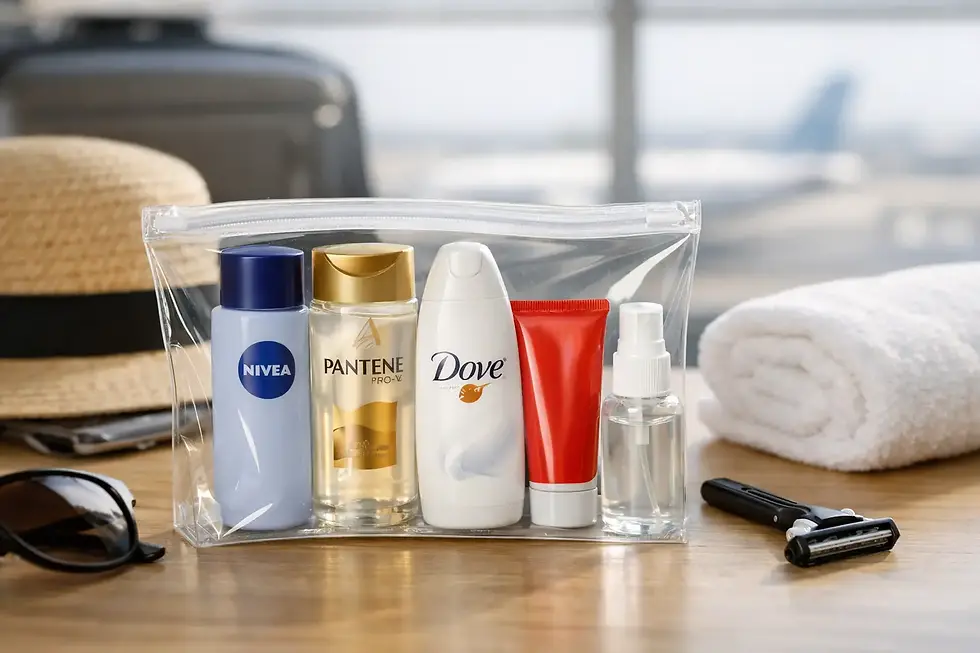
This is why travel-size products are more than a convenience purchase. They remove the guesswork. You do not need to decant toiletries into unlabelled bottles, wonder whether a cap will leak, or stand in Boots at the airport paying over the odds for last-minute replacements.
For frequent flyers and short-break travellers, ready-packed travel toiletries make even more sense. You pack once, know it fits the rules, and move on to more useful things like remembering your passport.
How to pack liquids without slowing yourself down
Good packing is mostly about reducing friction. If your liquids are all in the right sizes and easy to present at security, you are much less likely to get pulled aside for a bag check.
Start by separating liquid toiletries from the rest of your bag before travel day. If your airport still requires liquids to be shown in a clear bag, have that ready and accessible. Do not bury it under chargers, shoes and spare clothes. If your airport uses scanners that allow liquids to stay inside the bag, packing them together still helps if a manual check is needed.
It also helps to pack only what you will realistically use. For a two-night city break, you probably do not need a full skincare shelf or three hair products. The more selective you are, the easier your bag is to manage and the more space you keep for the things you actually need.
Pre-packed travel kits solve this neatly because the products are already chosen with cabin travel in mind. That is particularly useful if you are travelling for work, leaving early, or packing the night before and want one less thing to think about.
Airport liquid rules for common travel items
Some products raise questions every time. Toothpaste is treated as a liquid. Mascara is usually treated as a liquid. Sun cream and fake tan are liquids. Contact lens solution is a liquid. Liquid foundation and concealer are liquids too.
Aerosols can also fall under restrictions, especially toiletries such as deodorant, shaving foam and hairspray. Small travel-size versions are usually the safer option for hand luggage, but you still need to check the container size.
Medications are a separate case. Essential liquid medicines may be allowed in larger quantities, but you should check the airport and airline requirements in advance and carry anything supporting your need for them. Baby milk and baby food can also have different allowances when you are travelling with an infant.
That is why broad advice only goes so far. The standard rules work for most toiletries, but some categories depend on what the item is for and how you are travelling.
Why hand luggage travellers need a stricter approach
If you are checking a suitcase into the hold, airport liquid rules are much less of an issue for toiletries. But for hand luggage only travel, they affect almost every personal care product you pack.
That matters more now because so many airlines charge heavily for hold luggage, especially on short-haul routes. Travellers are trying to fit everything into a cabin bag, often for weekend breaks, business trips or short holidays. In that context, oversized toiletries are not just a compliance problem. They waste space.
Travel-size products help on both fronts. They are easier to get through security and easier to fit into a compact bag. You are not carrying bulky bottles for a trip that only lasts a few days, and you are less likely to repack at the last minute because something does not fit.
For couples or families sharing one cabin bag, this becomes even more useful. Shared essentials in the right sizes can cut duplication and free up space quickly.
When the rules change by airport
This is the part that frustrates people. You may hear that one UK airport allows liquids to stay in your bag, while another still wants them removed. Both can be true. Security technology is not being rolled out uniformly, and temporary changes happen.
So the safest approach is to separate two questions. One, do your containers comply with the usual size restrictions? Two, does your departure airport require you to remove them at screening? If you prepare for both, you avoid surprises.
This also matters for return journeys. Even if your outbound airport is straightforward, your destination airport may apply different procedures on the way home. If you buy toiletries while away, check the size before adding them to your cabin bag.
The easiest way to avoid mistakes
Most security issues with toiletries happen because people are mixing full-size bathroom products with hand luggage plans. They intend to sort it out later, run out of time, and end up hoping for the best.
A better approach is to keep a set of airport-ready essentials aside for travel. That could be a basic toiletry kit for weekends, a business-trip kit that stays mostly packed, or a few trusted refills you top up when needed. If every item is already chosen to fit airport liquid rules, you remove the awkward last-minute decisions.
That is exactly why travel-focused kits have become so useful. They are not about novelty. They are about taking a repetitive, slightly annoying task and making it simple. No repacking needed, no mystery bottles, and no standing at security wondering whether your face cream is about to be confiscated.
CabinCleared is built around that idea - familiar brands, travel-ready sizes, and less hassle before you fly.
Airport liquid rules are not difficult once your bag is set up for them. The trick is to plan for the airport you are actually using, pack to the stricter standard when in doubt, and make your toiletries the easiest part of the trip.

Comments